
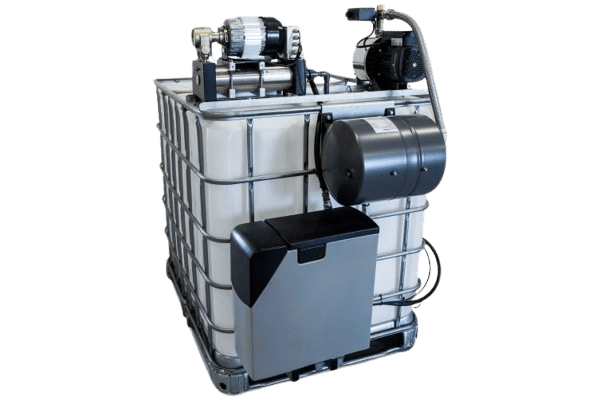
Reverse osmosis system
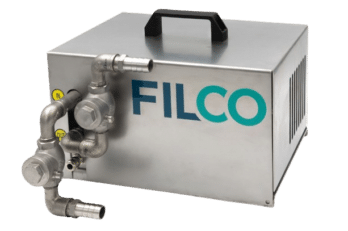
Reverse osmosis works by passing process fluids through 2–3 filters and an osmosis membrane. The filters typically consist of a sediment filter, a carbon filter, and sometimes another sediment filter, which ensure that the fluid is as clean as possible before it reaches the sensitive membrane.
The system works best when the liquid consists of water that needs to be completely purified of microscopic particles and contaminants. It is capable of removing nitrates, herbicides, hormones, drug residues, asbestos, fungicides, and bacteria, etc., from the water.
The systems are available with water tanks sized to meet the customer’s needs, and our team delivers, installs, and provides training on the use of the reverse osmosis systems, which are primarily supplied as part of our purification and filtration systems.
Table Summary: Reverse Osmosis Systems
| Number | Description | Buffer Tank (L) | Hourly Output (L) |
|---|---|---|---|
| 1000550 | Demi FILCO RO 401+Unisoft | 1000 | 180 |
| 1000644 | Demi FILCO Uniro 400S x 9020 | 2100 | 400 |
| 1000860 | Demi FILCO Uniro 800S x 9035 | 2100 | 800 |
Related Products
's Frequently Asked Questions
Which filter paper should I choose?
We always recommend contacting our advisor when selecting filter paper, and when recommending a product, we always consider the following:
- Type of filter system (is it a vacuum filter where the liquid is drawn through, or is it the liquid's own weight that causes it to flow through the filter paper?)
- The process fluid (here we examine viscosity, pH, and chemical composition)
- Impurities (what do we need to filter out of the liquid, and how small are the particles we're dealing with?)
- Flow (the volume and pressure at which the fluid flows)
Once we've reviewed the information above, we can determine which type of filter paper we recommend.
How do I choose the right thickness?
The thickness of filter paper depends on the application, and it is always recommended to start by considering the size of both the small and large particles present in the liquid you need to filter. Once you have a general idea of this, you can determine which thicknesses are ideal for your application based on the micron size.
When using filter paper to build a filter cake—which forms as larger particles clump together on the filter cloth, thereby filtering smaller particles out of the liquid—you need to determine what thickness of filter paper to use to ensure this process is successful. It is also important to choose a thickness that ensures satisfactory filtration without using more filter paper than necessary.
How do I choose the right material?
The choice of filter paper depends, among other things, on the type of liquid and the strength requirements for the paper. At ANMASI Group , we offer filter paper in three materials: polyester, polypropylene, and viscose.
To ensure the best solution, we recommend that you send us a data sheet for the liquid or describe the application. That way, we can advise you on the most suitable filter paper for the job.
How well do the different types of filter paper filter?
How effectively filter paper filters depends primarily on two factors: the material’s structure and its thickness. When evaluating filtration performance, we focus in particular on the filter paper’s ability to form a dense and thick filter cake, as this is often the best indicator of how effectively particles are retained in the liquid.
At ANMASI Group , we offer four different types of filter paper, each available in several thicknesses. The different materials and surface textures provide varying filtration results, making them suitable for a variety of applications.