
Washing, Filtration, and Maintenance Solutions for Workshops
Cleaning and Maintenance of Components
Whether it’s auto repair shops, the offshore and marine industries, food production, or heavy machinery, ANMASI Group has the experience to provide solutions for the job. We offer a wide selection of standard solutions and chemicals designed for cleaning and refurbishing engine parts, gearboxes, hydraulic components, and compressors, among other things.
The right solution always depends on the specific task at each workshop. That’s why we supply Spray washers, ultrasonic cleaners, Filtration systems , and evaporation systems. Workshops and maintenance departments often face a wide variety of challenges, which is why flexibility is a key part of our solutions.
When we talk about workshops and maintenance, we’re not referring to a single specific industry. Nearly all manufacturing companies deal with maintenance in one form or another. That’s why, over the years, we’ve built up experience with a wide range of different tasks and industries. Workshops that maintain aluminum and steel casting molds, or stamping tools for metal forming, are areas where we have provided countless solutions over the years.
There have been significant developments in this area in particular in recent years. The focus has been on both improving energy efficiency and using more environmentally friendly chemicals. This improves the work environment, reduces operating costs, and contributes to more sustainable operations.
Our Solutions
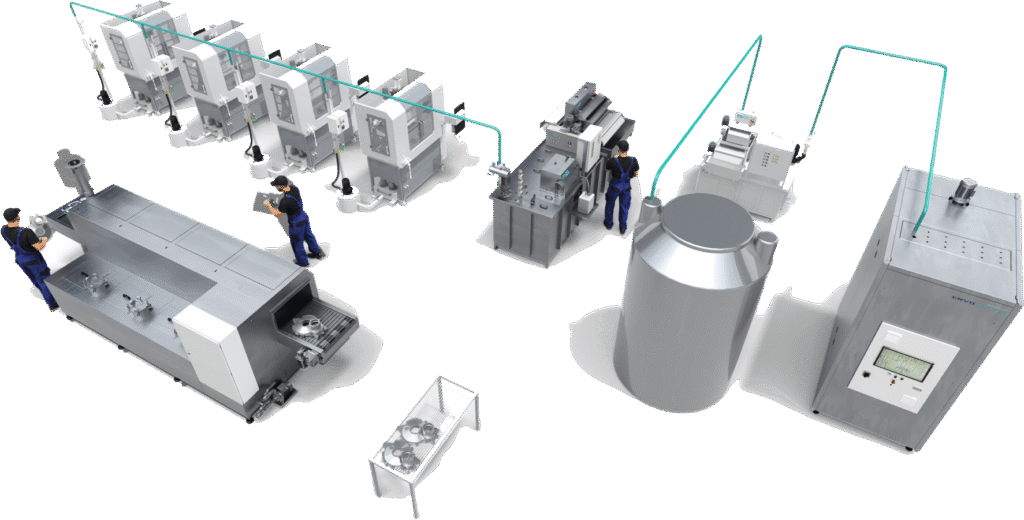
ANMASI Group consists of three specialized brands, each of which can function as a standalone solution or be integrated into a single, comprehensive process. When the solutions are combined, we call it a circular process solution.
This means we can clean the parts in production, filter process fluids, cooling lubricants, and wash water, and then evaporate them so that you can reuse them in production over and over again.
Customer Case Study: Focus on Optimizing Manual Tasks
At Ortlinghaus , the goal was to reduce maintenance and create a more efficient washing process in production. With a fully automatic washing system from ANMASI A/S, equipped with automatic filtration, a magnetic filter, and an oil separator, the need for frequent filter changes and manual checks was significantly reduced.
At the same time, the company achieved more consistent wash quality, fewer downtime incidents, and time savings of up to 1–2 hours per day on manual tasks. The result is a more efficient and low-maintenance solution that supports day-to-day operations at the workshop.
Frequently Asked Questions
-
What do you usually recommend for cleaning engine parts and tools during maintenance?
It always depends on the specific task. That’s why we start with a needs analysis, where we assess the size of the workpieces, contamination levels, cleanliness requirements, and the desired work process.
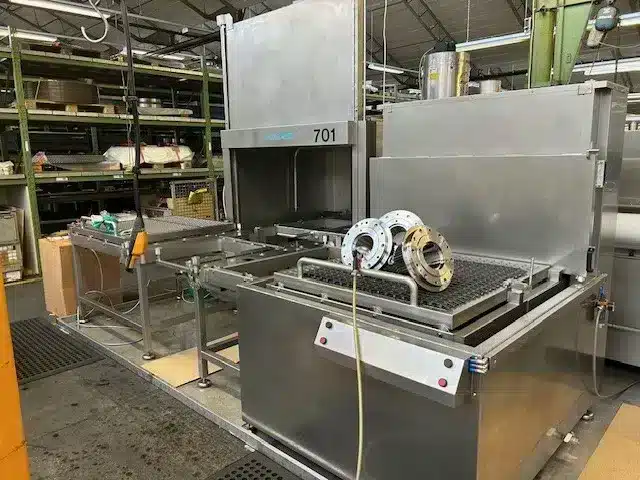
For maintenance tasks, however, we often recommend Toploader —or Frontloader —Spray washers. These systems are versatile and well-suited for cleaning everything from small components and tools to larger engine parts and machine components.
In many workshops, the rinse washer is combined with an industrial ultrasonic cleaner, such as the Maxi or Maximatic. This is because maintenance departments often work with many different types of parts and contaminants. The combination of a rinse washer and ultrasonic cleaning therefore provides a flexible solution that can handle a wide range of cleaning tasks.
-
When is an oil separator used?
An oil separator is used to remove free oil and unwanted oils from process fluids. It is particularly well-suited for applications such as wash tanks, machine tools, process fluid tanks, and wastewater treatment.
The oil separator draws oil from the surface of the liquid via a self-leveling suction head. The oil is then gently separated from the process liquid through a 2- or 4-chamber labyrinth system. The gentle pumping action prevents unnecessary agitation of the liquid, ensuring effective oil separation.
An oil separator is therefore a good solution when you want to keep the process fluid free of unwanted oil, extend the fluid's service life, and ensure stable processes.
-
When is a magnetic separator used?
A magnetic separator is used to remove magnetic particles from various liquids, such as coolant, process fluids, oil, and wastewater. It is particularly effective at removing iron oxide, graphite, and other magnetic particles.
The magnetic separator is equipped with a powerful magnet with a large surface area, which ensures efficient collection of particles. It can also be easily integrated into existing filtration equipment, such as directly onto a Band filter.
-
How important is it to have the right type of filter in your washing system?
Choosing the right filter is crucial for a properly functioning washing system. Effective filtration and oil separation ensure a stable washing process, extend the service life of the fluid, and reduce the need for maintenance.
During the washing process, dirt, oil, and other impurities are removed from the workpieces. If these contaminants are not continuously removed from the process fluid, they will accumulate and, over time, cause problems with cleanliness, operational reliability, and operating costs.
Filtration is therefore often one of the most important— yet most overlooked—factors in a washing system. At ANMASI Group , we help you find the right solution so you can get the full benefit of your investment and enjoy stable operation from day one.
That is precisely why, over the years, ANMASI Group has acquired three companies specializing in filtration, oil separation, and the evaporation of process fluids. This gives us unique expertise and an understanding of just how crucial fluid treatment is to the efficiency of a washing plant.