
Our Spray washers
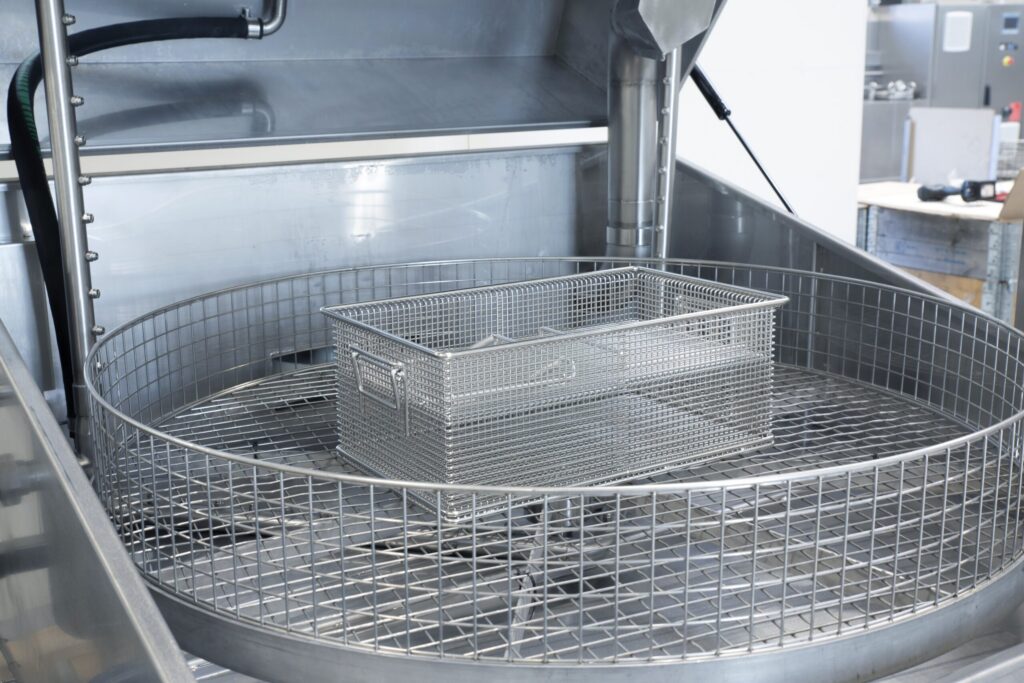
ANMASI Group We offer industrial Spray washers with Toploader and Frontloader for cleaning workpieces and components of many different sizes and materials. We offer both standard solutions and custom-designed washing systems, so the cleaning process can be tailored to the specific task.
Spray washers are particularly well-suited for cleaning large and sturdy items from which oil, grease, cooling lubricants, and other contaminants must be effectively removed. Depending on the need, the washing system can be configured to include washing, rinsing, and drying.
Watch the PRO Flush Washer in action
What can a Spray washer remove?
Flushing is used primarily to remove contaminants that arise during production, processing, maintenance, and repair.
A Spray washer can be used, among other things, to remove:
- Oil
- Cool
- Refrigerant lubricants
- Wood chips and particles
- Production scraps
- Dust and dirt
- Soot
- Epoxy, glue, and paint
- Other process-related impurities
The cleaning chemicals and process used are tailored to the type of contamination and the material to be cleaned.
The Benefits of Industrial Flushing
Rinse washing is particularly effective for removing oil, grease, and cooling lubricants, which are often found on machined components.
This technology is well-suited for larger components, machine parts, tools, and other items where manual cleaning can be time-consuming.
A closed-loop washing system can reduce the need for manual cleaning and limit employees' exposure to cleaning chemicals and dirt.
Pressure, temperature, cleaning chemicals, nozzle placement, and processing time can be adjusted so that the cleaning process is tailored to the parts and the desired cleaning result.
Would you like us to help you optimize your process?
Frequently Asked Questions
Does ANMASI Group offer service and support after delivery and commissioning?
Yes, ANMASI Group offers service and support—even after the delivery and commissioning of your system.
As a full-service provider, we offer a comprehensive service concept in which we work with you to tailor a service agreement to your needs. Among other things, we can handle the emptying, cleaning, and refilling of your washing systems, as well as the replacement of filter paper and filter bags.
If wear and tear or malfunctions occur in your washing, filtration, or evaporation systems, we can also assist with repairs and troubleshooting. Our service helps ensure high operational reliability, minimize downtime, and extend the system’s service life.
Learn more about our service concept Here.
When should you use a rinse wash to clean workpieces?
Flush washing is primarily used for cleaning and degreasing larger workpieces and components to remove oil, grease, cooling lubricants, polishing paste, soot, or metal shavings.It is a versatile cleaning process used in production, machining, and maintenance, among other applications.
Spray washers are particularly well-suited for large items and are available in both Frontloader and Toploader versions. Depending on your needs, the systems can be combined withwashing, rinsing, and dryingto achieve the desired cleaning results.
Can we buy chemicals, filter bags, and filter paper at ANMASI Group?
Yes, at ANMASI Group , you can order chemicals, filter paper, and filter bags for your solutions.
We also have a consumables warehouse in New Jersey, USA, from which we can supply chemicals, filter paper, and filter bags to our international customers.
We’d be happy to advise you on the right combination of chemicals, filter paper, and filter bags to best suit your process and needs.
When is it usually best to choose a drum washer ( Frontloader)?
A chamber washer with Frontloader is typically best suited for large and heavy parts that require efficient and flexible cleaning—especially in repair shops, for molds, and after machining. The parts are placed directly into the wash chamber, and the system can handle both small and very large components, including those handled by an overhead crane.
The chamber washer is available in various sizes and can be customized for specific tasks, making it suitable for both production and maintenance.